
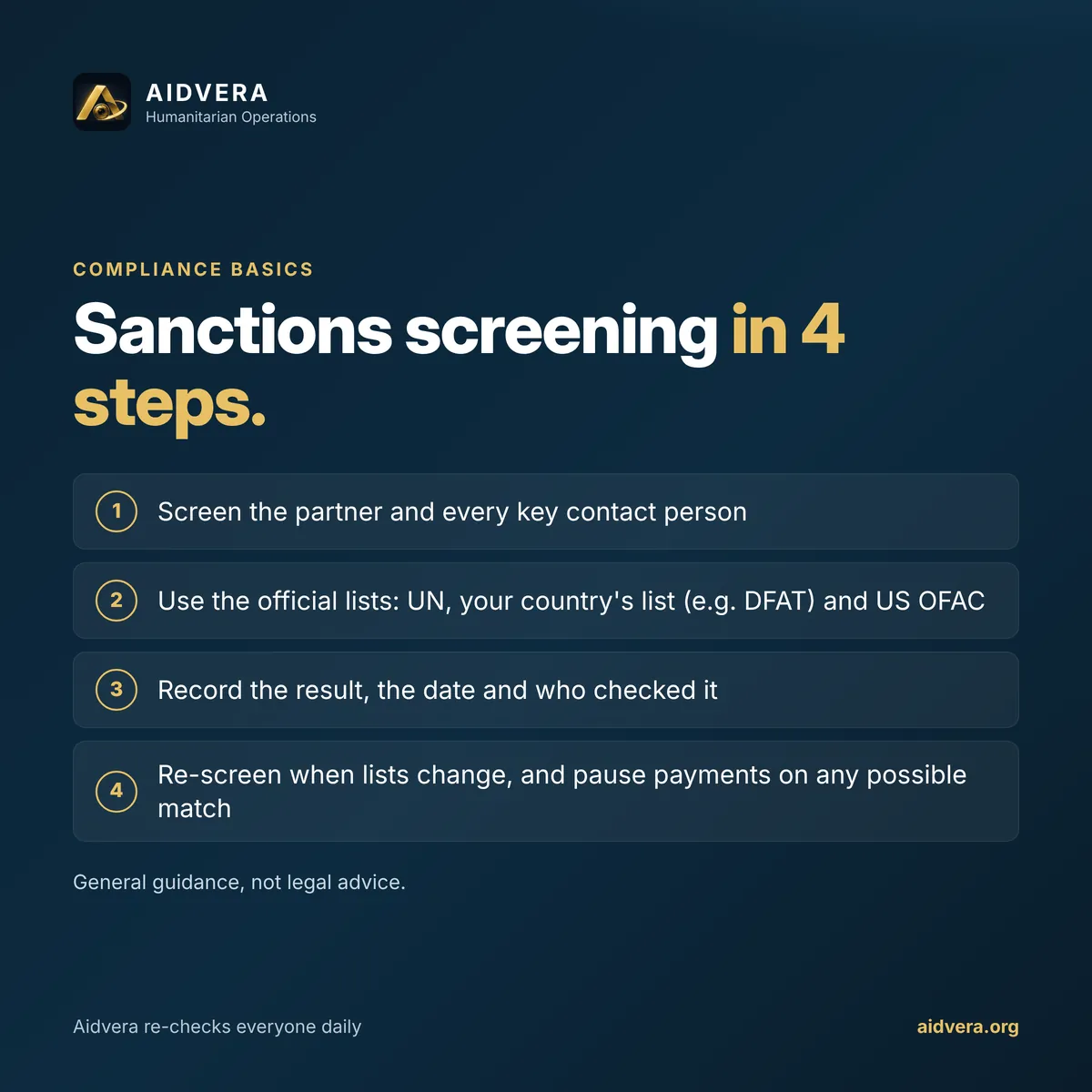
Sanctions screening isn't only for big agencies. If you send money to partners or pay suppliers overseas, your donors expect it, and so do the banks. The good news: a simple routine covers most of what a small or mid-size NGO needs.
Step 1. Screen the organisation and its key people
Screen the partner organisation itself and every key person: directors or board members, the main contact, and anyone who signs agreements or receives payments. Screen suppliers too when you pay them directly.
Step 2. Use the official lists
The usual starting point is:
- the UN Security Council Consolidated List;
- your own country's list, for example the Australian DFAT Consolidated List, or the UK or EU lists;
- the US OFAC list if you pay in US dollars or work with US funding.
Your donors may name other lists in their agreements. Check what each grant requires.
Step 3. Record the result
For every check, record who or what was screened, which lists, the date, the result and who did the check. If there was a possible match, record how it was resolved and by whom. "We checked" is not evidence; a dated record is.
Step 4. Screen again when the lists change
This is the hard part. Sanctions lists change constantly: names are added, removed or updated, sometimes several times a week. A partner who was clear in January may not be clear in June. Re-screen at least before each payment, and whenever the lists are updated. While a possible match is being reviewed, pause payments to that partner or supplier.
What a possible match means
Most possible matches are false positives: a common name, a similar spelling. Don't panic, and don't ignore it. Compare dates of birth, nationality, addresses and other identifiers, record your decision, and ask your compliance adviser if you are unsure.
How Aidvera helps
Aidvera downloads the UN, DFAT and OFAC lists every day and re-checks partners, their key people and suppliers automatically. Each result is recorded with its date, and a possible match blocks payments to that partner until someone reviews it.
This is general guidance, not legal advice. Check your own obligations with your compliance adviser.
See it on your own partner projects
Free 30-day trial, with onboarding and weekly check-ins. No obligation.